
Banking on DNA: Thinking about new genetic tests in comparative contexts
Date:
-
Location:
Taylor Education Building Auditorium
Tags/Keywords:
By Gail Hairston
Imagine exploring and mapping a newly discovered cave opening. At this point, there is only one set of questions--how long, deep, tall, wide, etc. is the passage, and where does it go? But as you begin to map it, more often than not, other passages and fissures will be discovered (and many of them will lead to others, and so on). This opens up a whole new set of questions. Some of the passages can be mapped, assuming someone can get the time and resources. Others can't be no matter how skilled the spelunker; they are too small. But even these can possibly be explored later, perhaps with remote control or AI tiny robots or probes; or with imaging techniques that can see through rock.
This is a pretty good metaphor, I think, for research in general. The more you learn, the more you discover you don't know, and more potential pathways for research appear--some possible now, some awaiting new techniques.
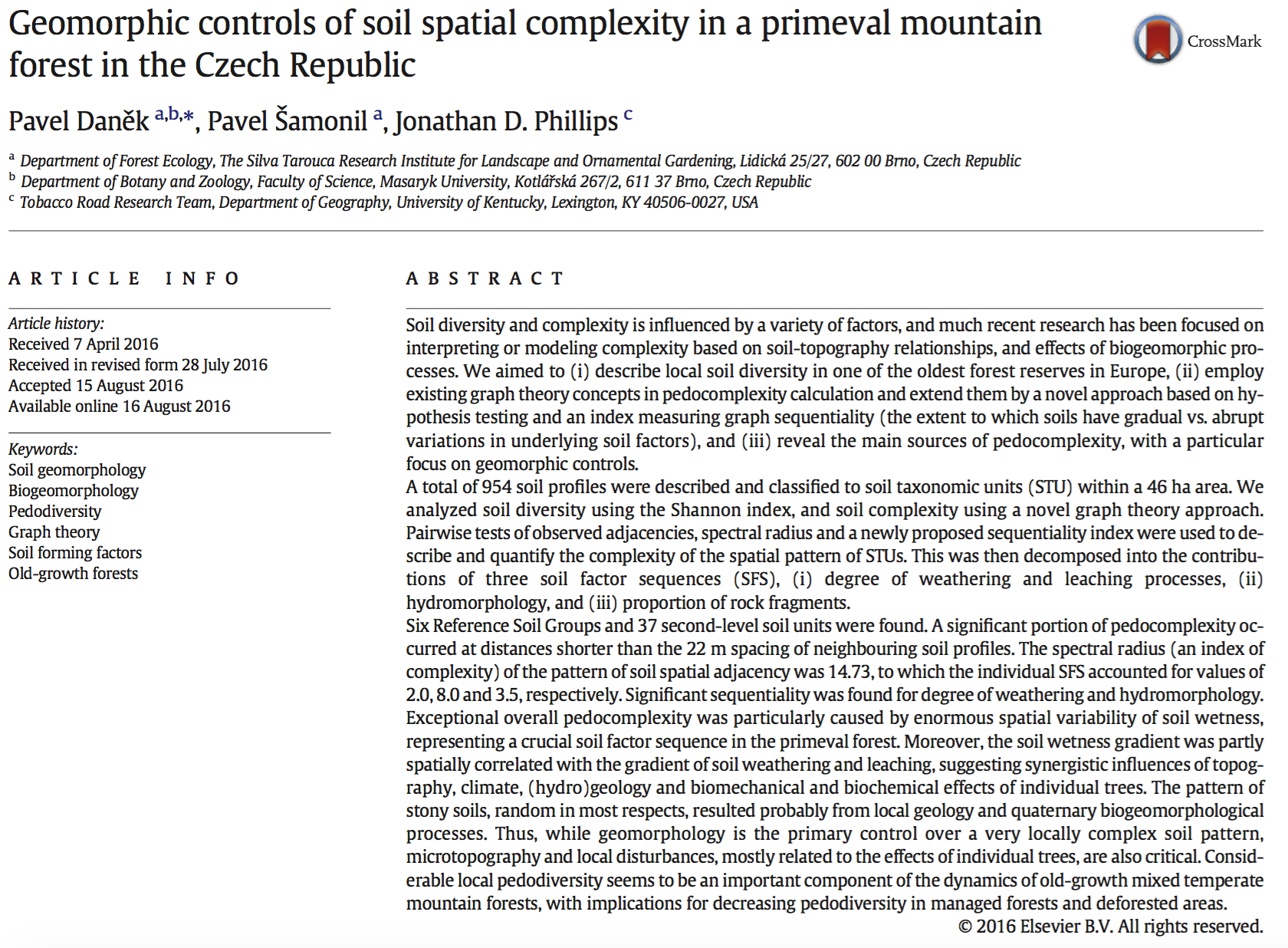
A forest biogeomorphology two-fer, courtesy of my central European boyz, who have graciously allowed me to ride their coattails here in the twilight of my career. The first is one where Pavel Daněk took some of my ideas and methods on applying graph theory to soil geomorphology, and went places with them I never even imagined:
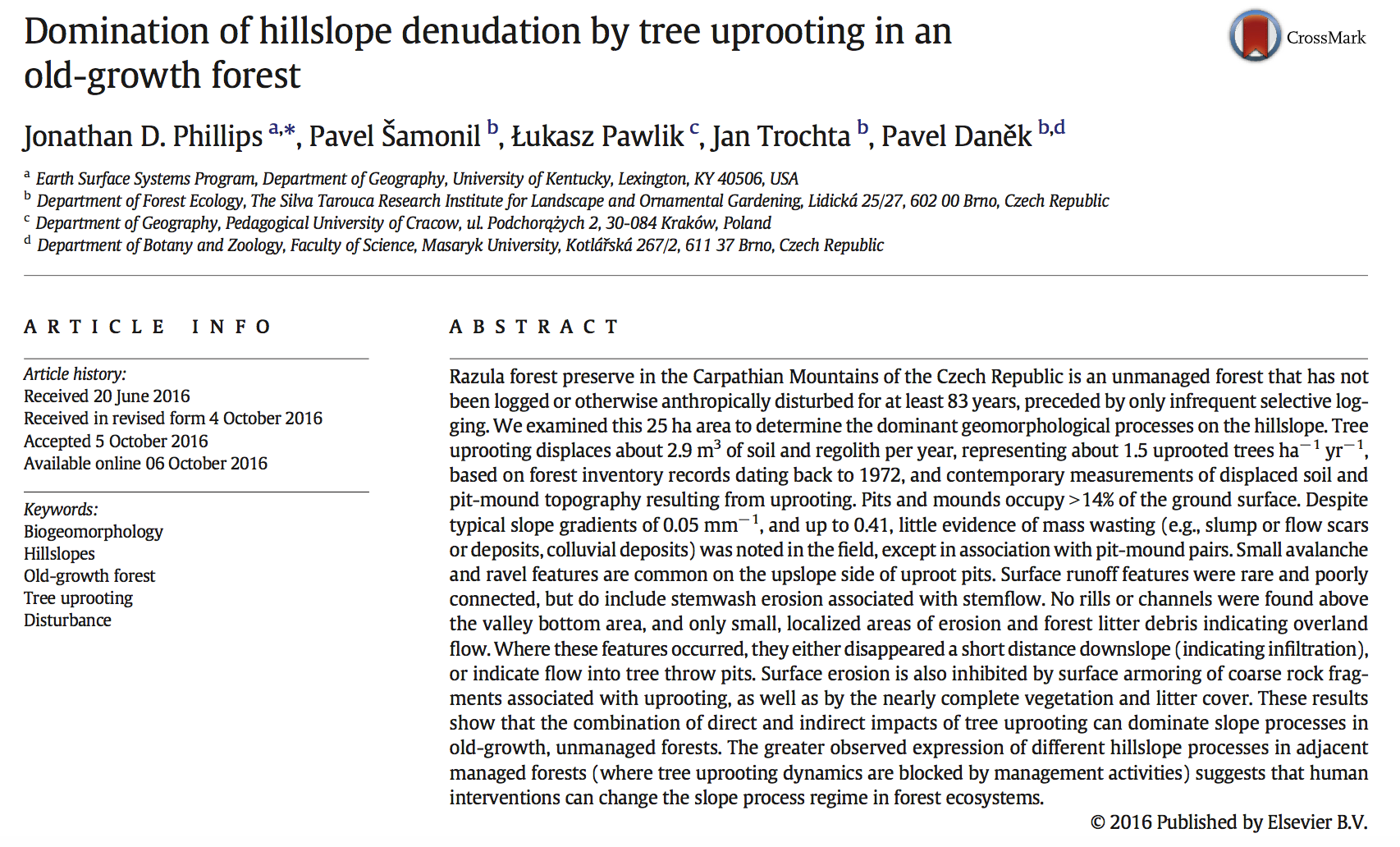
The second is one that arose when Pavel Samonil took me to one of his field sites, where I saw things I hadn't imagined:
The abstracts are below.
In the brief biography on my departmental web page, I refer to myself as the "author of a vast number of widely-ignored articles." This statement reflects the lifelong tug-of-war between my inherent boastful, egotistical leanings and the humility my parents tried, with mixed success, to instill. Thus the boastful "vast number" juxtaposed with the humble "widely ignored." The latter, by the way, is based on the relatively low number of citations and other metrics generated by ISI, etc., compared to the most popular and influential scholars.
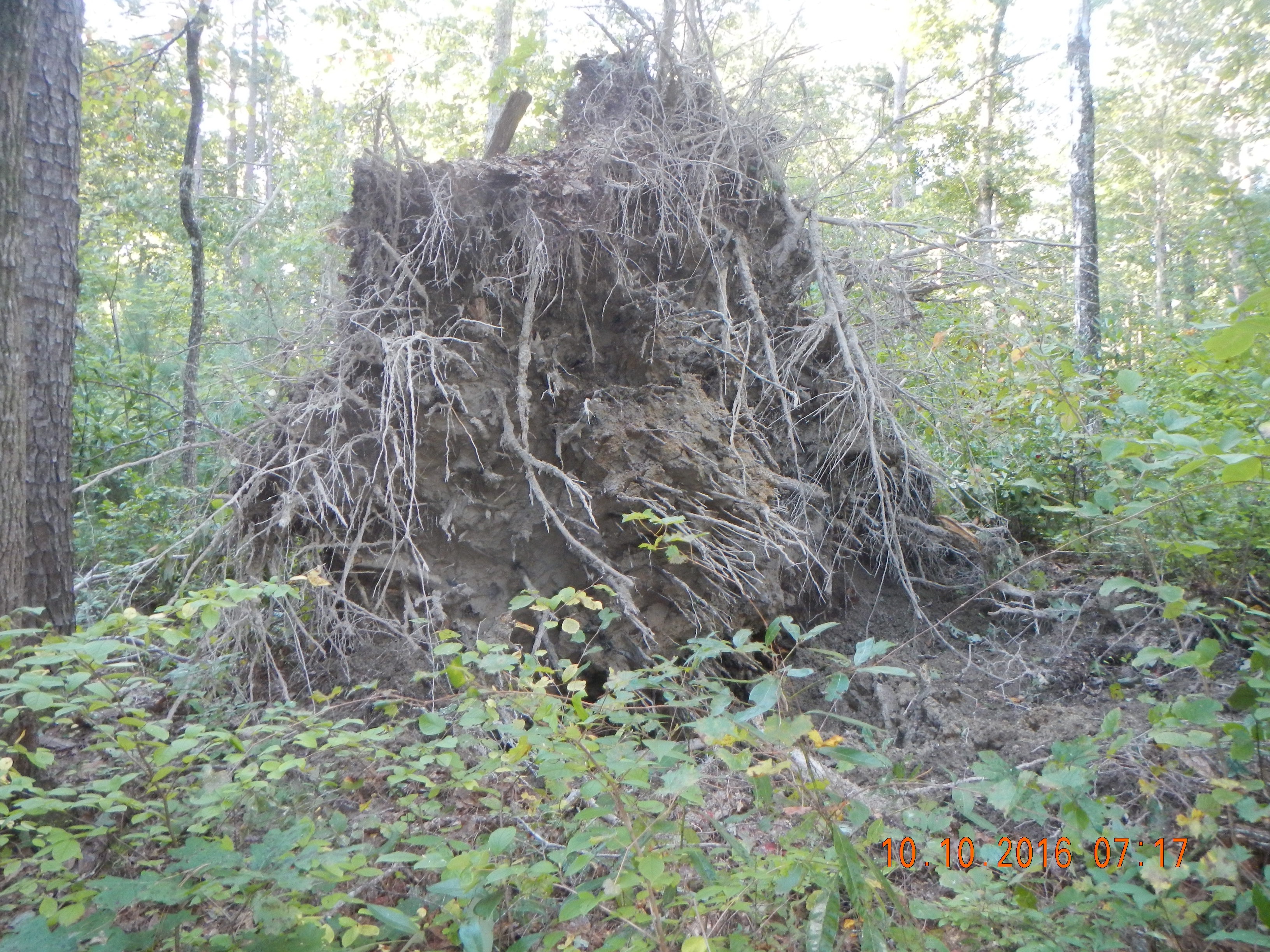
Hurricane Matthew devastated Haiti and other Caribbean areas, and did tremendous damage in Florida and South Carolina (I rode out the storm in Myrtle Beach, SC with my son Nate, his wife Morgan, and my delightful 2-year-old granddaughter Caroline). By the time it got to North Carolina, winds were down to gale force, but rain was ferocious (15 to 40 cm) in much of eastern N.C. Where I am at the moment, in Croatan, there was "only" about 10 cm of rain, and only gale force winds. However, that was enough, as it usually is, to get some geomorphic work done in the forest.
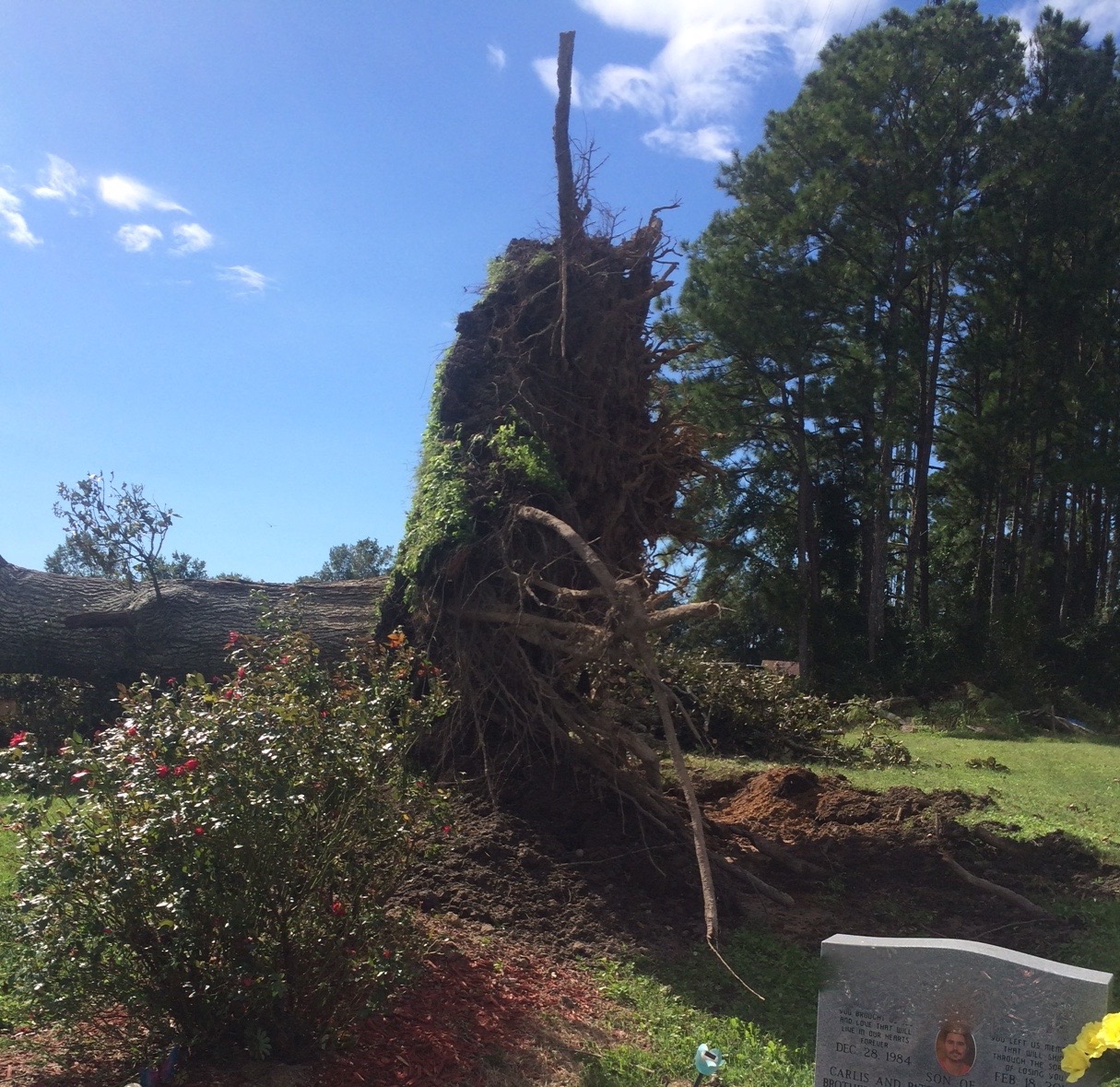
Below are some photos of trees uprooted by the storm in Croatan National Forest in the Flanner Beach area. Uprooting not only does significant soil mixing, but the pit-mound topography left behind significantly influences hillslope and soil processes for decades (and occasionally longer) thereafter.
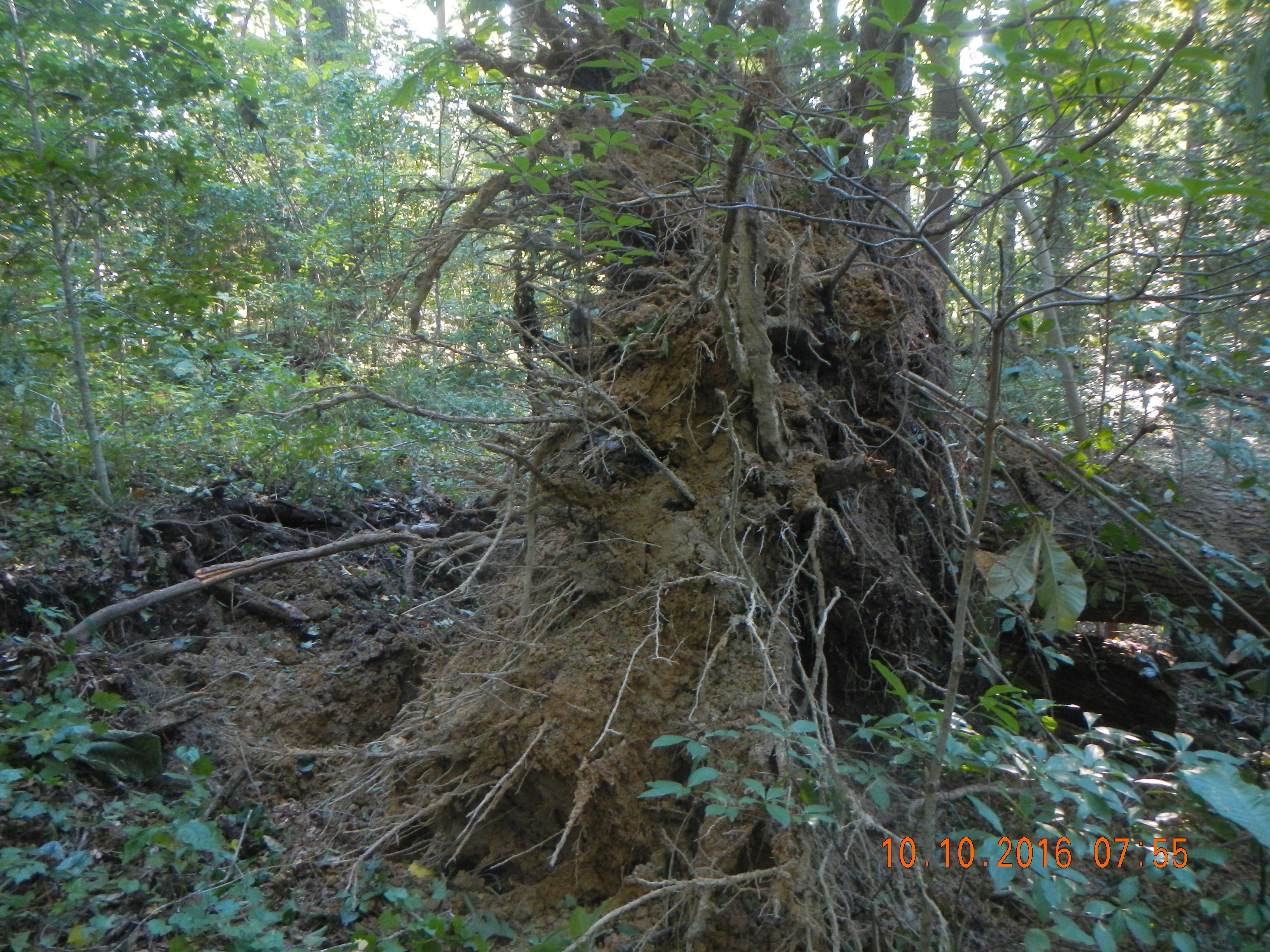
Another example from a cemetery near Maysville, N.C.
"Rethinking Digital Inequalities: The Experience of Favela Residents in CTCs"
David Nemer, Assistant Professor in the College of Communication and Information, School of Information Science at the University of Kentucky
Information and communication technologies (ICTs) have emerged as symbols of modernity in both the developed and the developing world, and currently are seen as bridges to promote social and digital equalities. Because ICTs have been imported from the center, United States and Western Europe, to nations on the periphery, they are often perceived as sites of resistance and struggle between governmental policies, economic conditions and international players. Thus, approaching computers with the perspective of the marginalized offers a different window for understanding technological use, political processes, social tensions and cultural values, especially of those experiencing digital inequalities. Based on fieldwork over eight-months in the favelas (urban slums) of Vitória, Brazil, my research focuses on the motivations, engagements, and adoption of ICTs by marginalized people in community technology centers (CTCs). It asks the following questions: (1) what is their experience using CTCs? (2) How does their experience inform the ways we should think about what constitutes empowerment vis-à-vis ICTs? This study emphasizes the socio-cultural aspects of ICTs practices among marginalized people and attempts to understand such aspects and practices from their perspective. It argues that theoretical positions stemming from technology utilitarianism need expanding, because mundane and non-instrumental practices observed in the favelas shed light on the importance of technology in a variety of dimensions within people’s lives. Encompassing such practices contributes to a broader comprehension of the engagements and ingenious strategies that help shape the daily use of technology by marginalized people.
Geography Matters! Sediment Patterns Help Explain Past Environments in the Upper Great Lakes Region
Randall Schaetzl, Professor in the Department of Geography at Michigan State University
A goal of geomorphology is to explain the genesis of physical landscapes. In this talk, I will outline my years-long strategy and methods used to sample wind-blown sediments, mainly loess, across Wisconsin and Upper Michigan. By examining these sediments spatially, our research group has been able to make new inroads into understanding the climatic and geomorphic environments of the region, both during and after the Late Glacial Maximum (ca. 25,000-12,000 yrs ago). A recurring theme of the talk will be that a geographic approach to geomorphology can, in certain circumstances, have clear advantages.
"Geographies of transition and opportunity in Appalachia: rebuilding the economy from the ground up"
Coalfield Development operates a family of social enterprises in Central Appalachia. This talk will discuss how Coalfield Development is working to rebuild the regional economy through on-the-job training, education, and personal development. A specific focus will be placed on Refresh Appalachia, a social enterprise working to build a local food economy through farmer training, food hub development, and food access.
Ben Gilmer is president of Refresh Appalachia, a social enterprise of Coalfield Development. Ben has 15 years of experience in the non-profit, government, academic, and private sectors. Born and raised in Russell County, Virginia, his specialties include sustainable agriculture and food systems, economic and community development, natural resource management, and GIScience. He has worked on projects in the U.S., Latin America, Asia-Pacific, and the Caribbean. Ben has a Masters degree in Geography from West Virginia University and a BSc. degree in Geography from Radford University.
About Coalfield Development and Refresh Appalachia:
Coalfield Development operates a family of social enterprises in agriculture, solar, construction, woodworking, reclamation, and arts-based tourism. Coalfield Development's Refresh Appalachia is a regional economic and workforce development initiative to establish a training and development program that increases the success of farmers in Central Appalachia, strengthens local food systems, increases access to healthy food, and aggregates and distributes local products to regional markets.