
Living the DREAM, Contesting Citizenship and Building Democracy: Undocumented Migrant Youth in Action

Date:
-
Location:
18th Floor, POT
Tags/Keywords:
UK Women's Forum Celebrates Sarah Bennett Holmes Award Nominees
By Kristie Law
The University of Kentucky Women's Forum announces 14 women have been nominated for the 2018 Sarah Bennett Holmes Award, one of UK's most prestigious awards for women. Women's Forum, who established the award in 1994, is currently celebrating over 26 years of open discussion and creativity while providing leadership development for all women employed at UK.
FLUVIOKARST CHRONOSEQUENCES
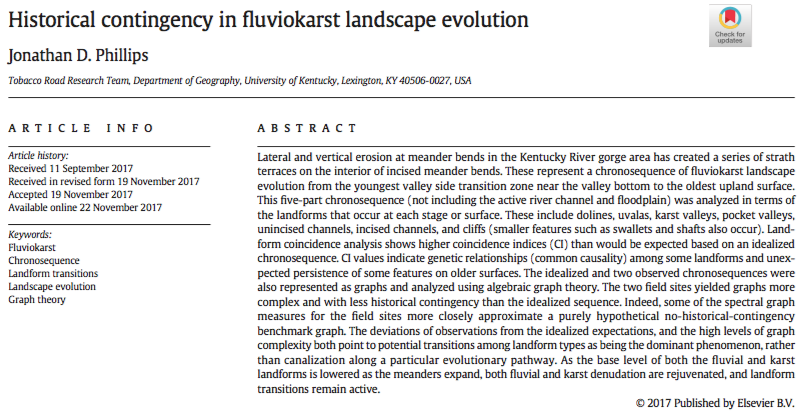
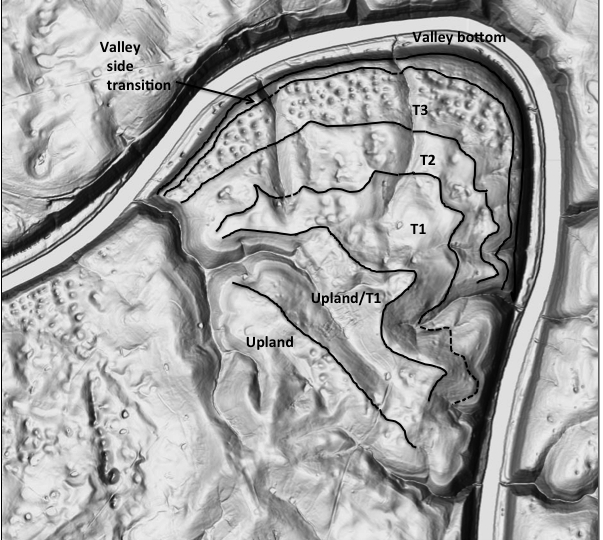
Historical contingency in fluviokarst landscape evolution was just published in Geomorphology 303: 41-52. When I first came to central Kentucky in 2000 I began noticing the strong contrasts in landscape and landform development on inner vs. outer Kentucky River incised meander bends. Investigating this and related phenomena has occupied me off and on ever since. Only a few years ago I realized that given the nature of bend development over the past 1.5 Ma or so, the bend interiors represent a chronosequence of landforms. This paper exploits those chronosequences, using graph theory, to explore the role of historical contingency.
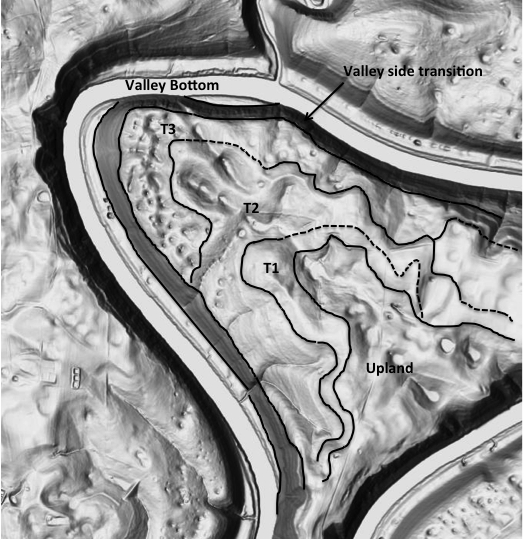
Chronosequence of strath terraces (T1, T2, T3) and other geomorphic surfaces at Polly’s Bend, Kentucky. The surfaces nearest the river are youngest; those farther away are oldest.
DOES RAINDROP SIZE MATTER?
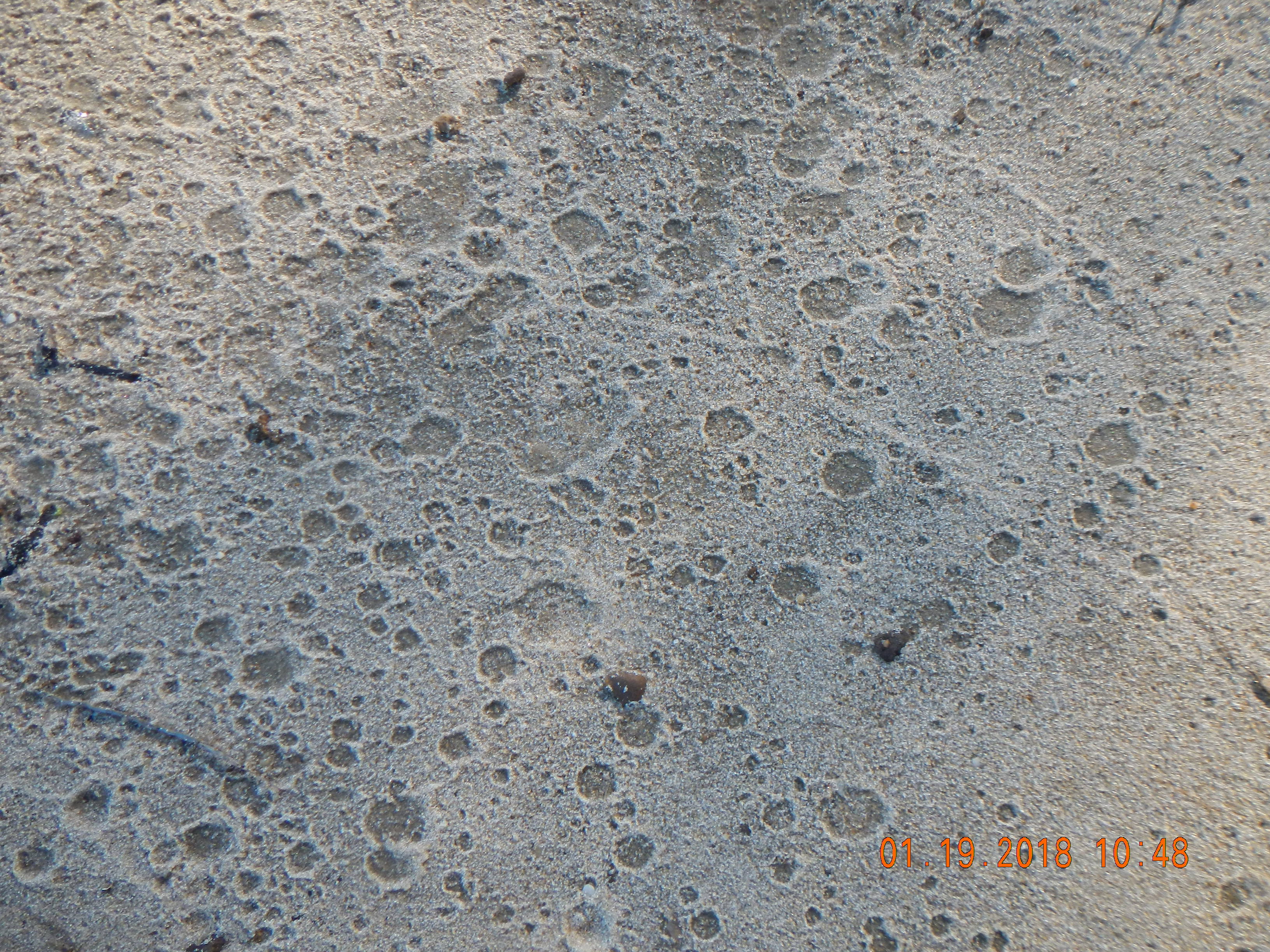
Below is a picture of raindrop impact craters after a rain last month on a beach along the Neuse River estuary, N.C. The spot pictured has no overhanging trees or anything else, so the craters represent direct raindrop impacts. As you can see, assuming crater size is related to drop size, they represent a large range (the largest craters pictured are roughly 10 cm in diameter; the craters must be at least slightly larger than the drops). Rainsplash is a significant factor in soil erosion--even if not directly important, the process is key for dislodging grains or particles that are then transported by runoff. Drop impact also influences surface crusting and sealing, and thereby hydrological response. So, I got to thinking, what is the potential significance of such a large variation in drop size?
Kinetic energy is given by KE = 0.5 m V^2, where m is mass in kg, and V is velocity in m/sec. A 2 mm diameter raindrop has a mass of 4.19 mg and a terminal velocity of about 6.26 m/sec. This gives a kinetic energy of about 0.00008 joules per raindrop.

LOCAL ANOMALY OR CULTURAL SHIFT?
In my experience, beer cans and bottles discarded as litter in the kinds of places where I recreate and do field work are about 80 percent Bud Light, 17 percent other undrinkable watery American light beers, and 3 percent all other brands combined. Recently, however, at a site along the Neuse River, North Carolina, the two dozen or so trash bottles I saw on the ground included NO Bud Lights!
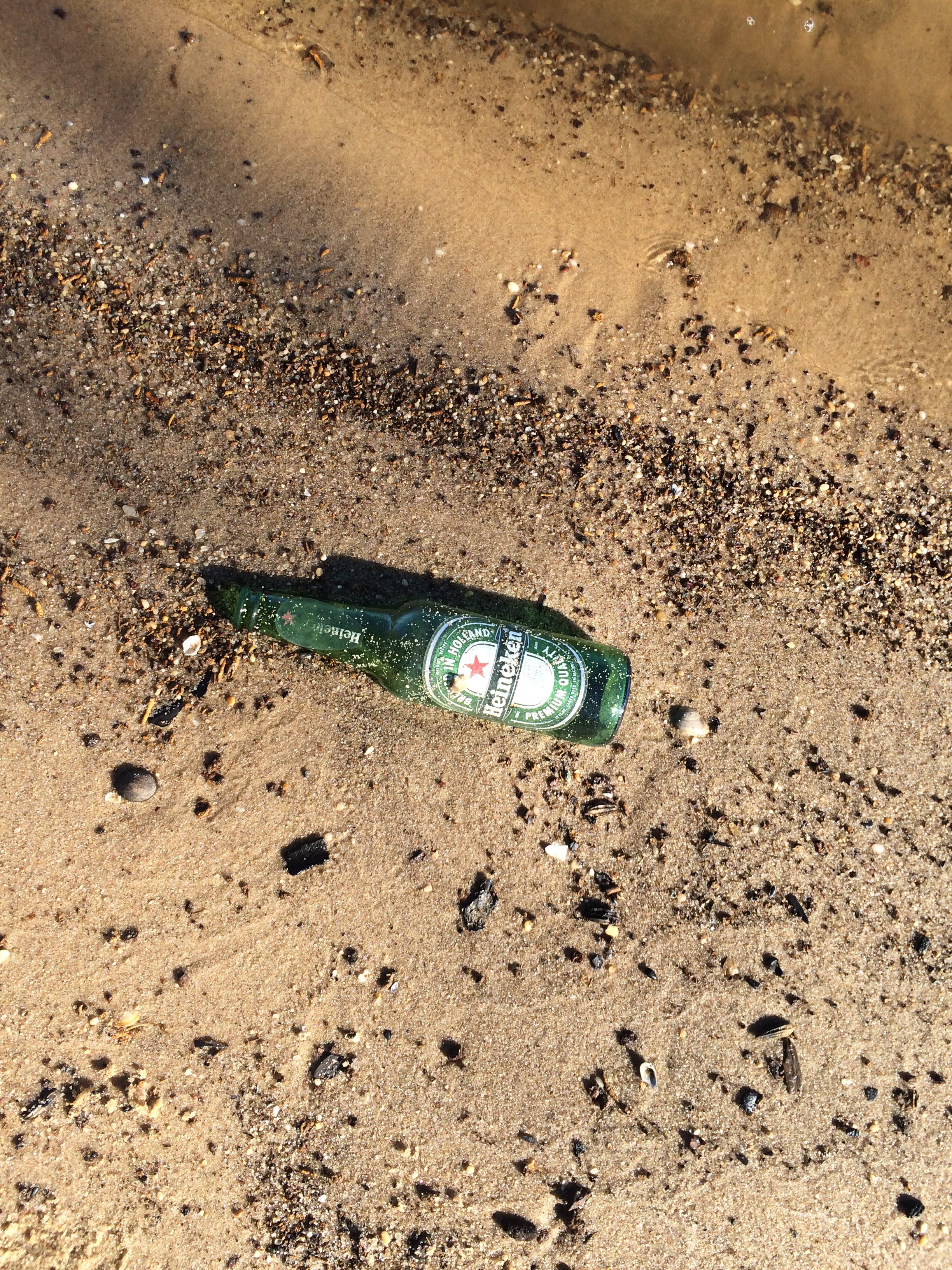
I am not well versed enough in contemporary cultural or economic geography to speculate as to whether this is a local anomaly, a shift in taste preferences for the kind of sh*tbag Bud Light drinkers who trash the countryside, or an expansion of litterbug behavior beyond the Lite beer crowd.
Of course, when it comes to beverage container trash, no brand of beer, soda pop, or anything else comes close to the mass or volume of plastic water bottles. Why don't you people use canteens, reusable bottles, or at least recycle these things?
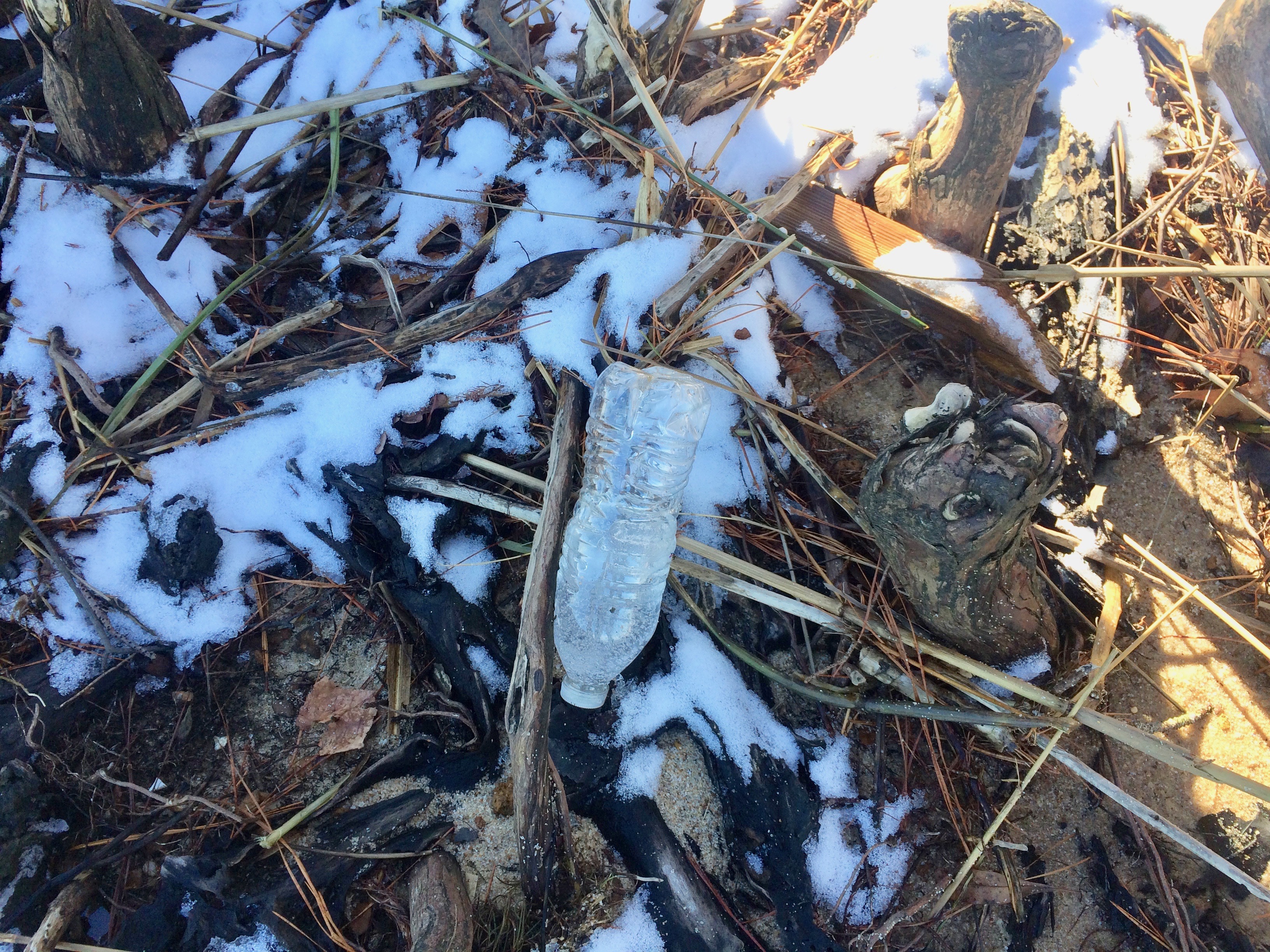
Posted 22 January 2018
BIRTH OF FERRICRETES
Ferricretes are soil or sediments cemented together by iron oxides. In eastern North Carolina, reducing conditions often prevail on the broad, flat interfluves. Under these conditions Fe is reduced, and soluble. Groundwater flow from these areas toward the major river valleys transports this dissolved ferric iron. When the groundwater discharges along the valley side slope it comes in contact with oxygen, and the iron oxidizes to its ferrous form. These iron oxides coat whatever material exists at that location--sand, clay, etc.
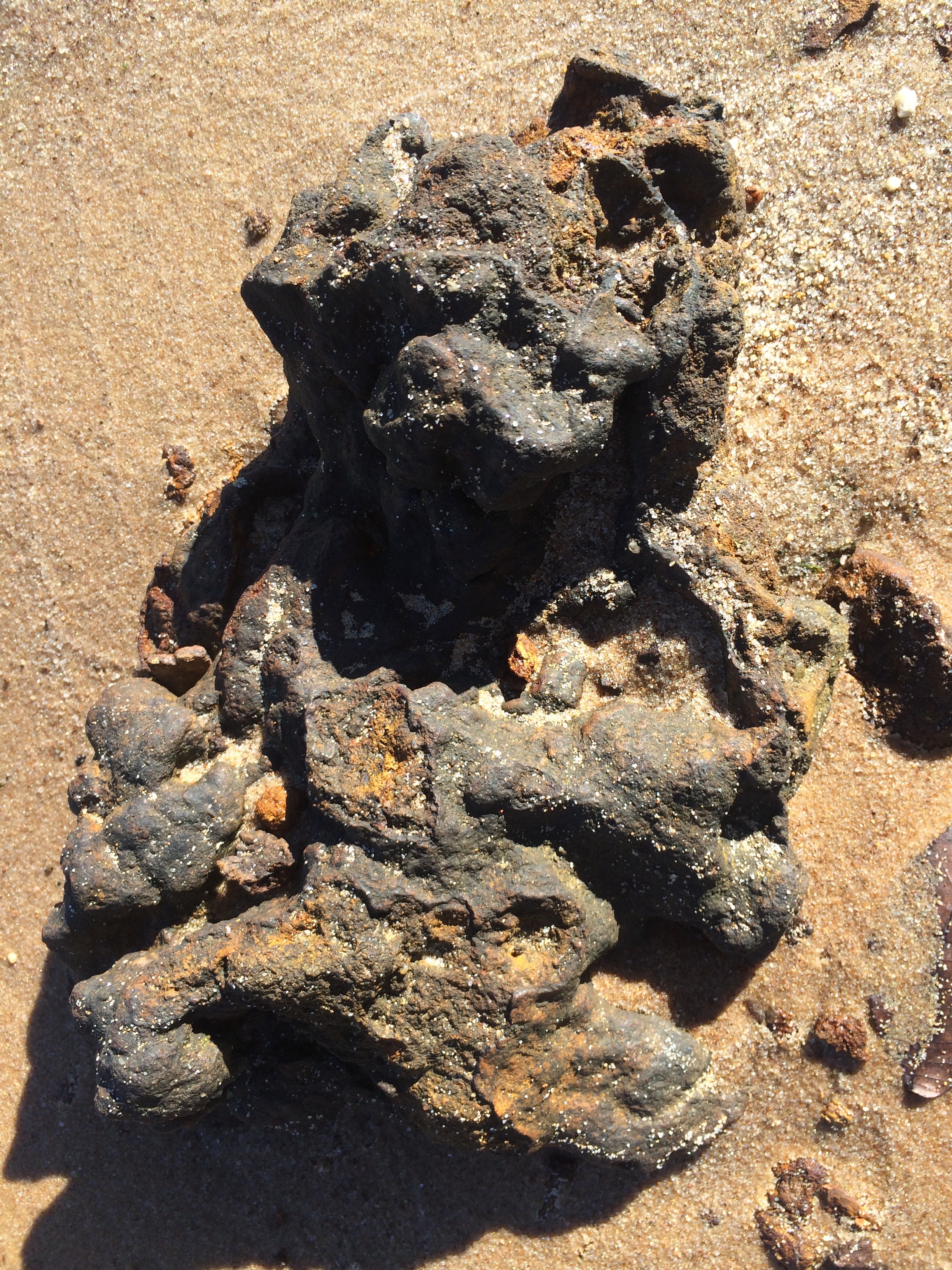
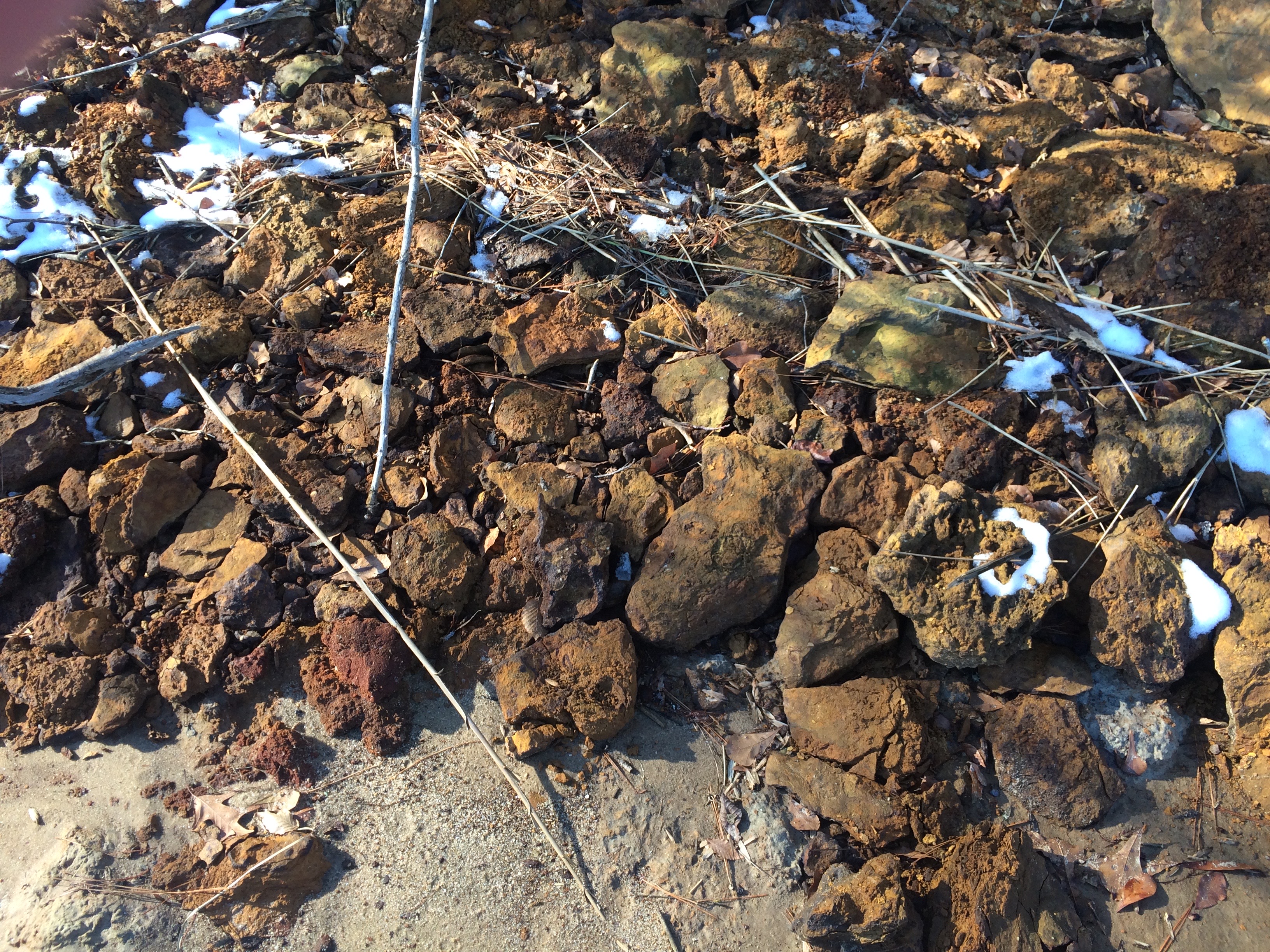
Limonite ferricrete at Fishers Landing, NC. The piece at the top is about 40 cm long.
When these iron-coated materials are exposed, typically by bank or shoreline erosion, they harden into rock-like ironstones--ferricretes. Once the Fe-coated material is exposed, it can harden very rapidly; within a year or two. They are hard enough so that geologists erroneously interpreted them as sandstone layers into the 1990s. When I read about a similar ferricrete formation process in Australia, I realized that the ironstone I'd been seeing might be formed the same way; some of them were very clearly NOT sandstones.
Love in the Eyes of Competitors: China's Mass-Mediated Loveland in the Neoliberal Universe
Date:
Location:
Room 334 Whitehall Classroom Building
Environmental Risk Reduction Research in Rural Communities: Tobacco and Radon Exposure
Date:
Location:
Room 334 Whitehall Classroom Building